In short
The analog revival is the search for objects, experiences and spaces that work away from the screen, valued for ownership, touch and presence rather than practical use. The data shows the movement growing among younger consumers and already shaping purchase decisions. For brand, product and architecture, value is shifting toward what can be felt by hand: texture, material and finish.
There is a kind of value the internet cannot replicate: the weight of an object in your hand, the scratch of a needle dropping into the groove of a record, the certainty that this particular copy is the only one that exists exactly this way. For years, the market treated it as niche nostalgia, a collector’s thing. The latest consumer behavior data tells a different story: a growing share of people, especially younger ones, are paying to go offline again, and paying for objects with no practical advantage over their digital version. Understanding why this is happening matters directly to anyone working in brand, product or physical space, because the phenomenon has less to do with nostalgia and more to do with a very specific gap that the digital world opened and cannot close on its own.
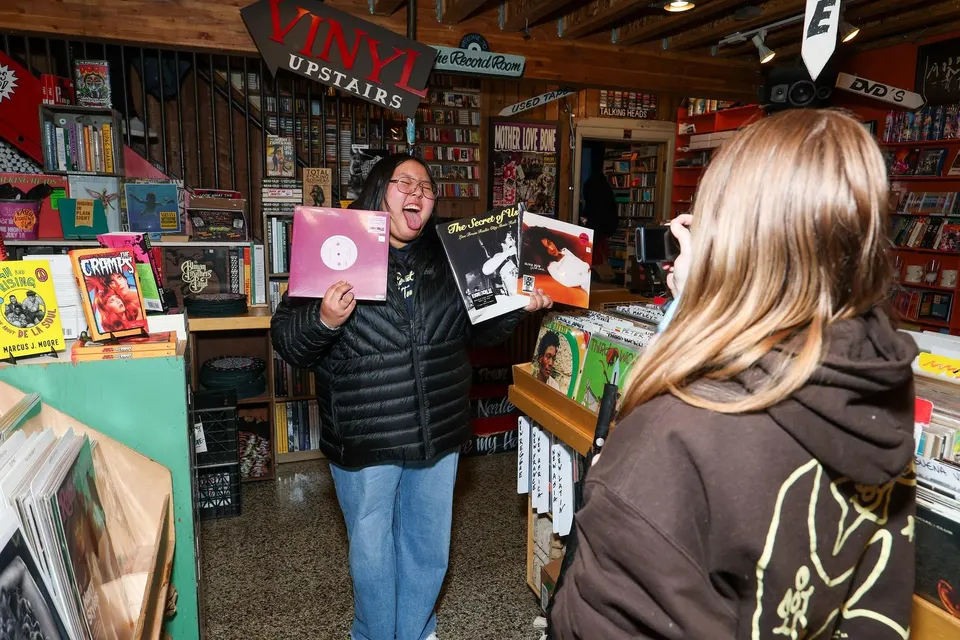
Photo: Mat Hayward/Getty Images, via Forbes.
Why are consumers buying back what they already had?
The most visible case is music. In the United States, vinyl sales grew in 2025 for the 19th year in a row and passed $1 billion, a mark the format had not reached since 1978, at the end of its heyday [2]. The detail that matters is not just the total, it is who is buying: according to WGSN, 60% of Gen Z bought vinyl records in 2025, even though 28% have no turntable at home, and 42% bought cassette tapes they cannot play [1]. The physical object is no longer a way to access content, because the screen already does that; it has become the product itself: proof of ownership, a piece for the shelf, a statement of identity that a playlist does not carry.
The same pattern repeats in other categories, from film cameras to paper notebooks, and reveals an important distinction: what a product does and what it means are different things, and the market is learning to charge for each one separately.
“Owning is no longer about access. It is about holding: this is mine, it has weight, it takes up a place no one can sync to the cloud.”
Why do so many people want to go off the grid?
On the behavior side, the signal is even clearer. About half of consumers worldwide already try to cut their screen time on their own [1], and among younger people the movement is twice as strong: a generation that grew up with a phone in its pocket is also the first to say, survey after survey, that it would like to use those same tools less. In a Harris Poll survey of 18- to 27-year-olds, more than one in five said they wished the smartphone had never been invented [3].
An experiment published in the scientific journal PNAS Nexus blocked mobile internet access for a group of volunteers, keeping only calls and text messages, and measured the effect after two weeks: 91% of participants reported improved well-being, and the free time went to conversation, exercise or simply getting out of the house [3].
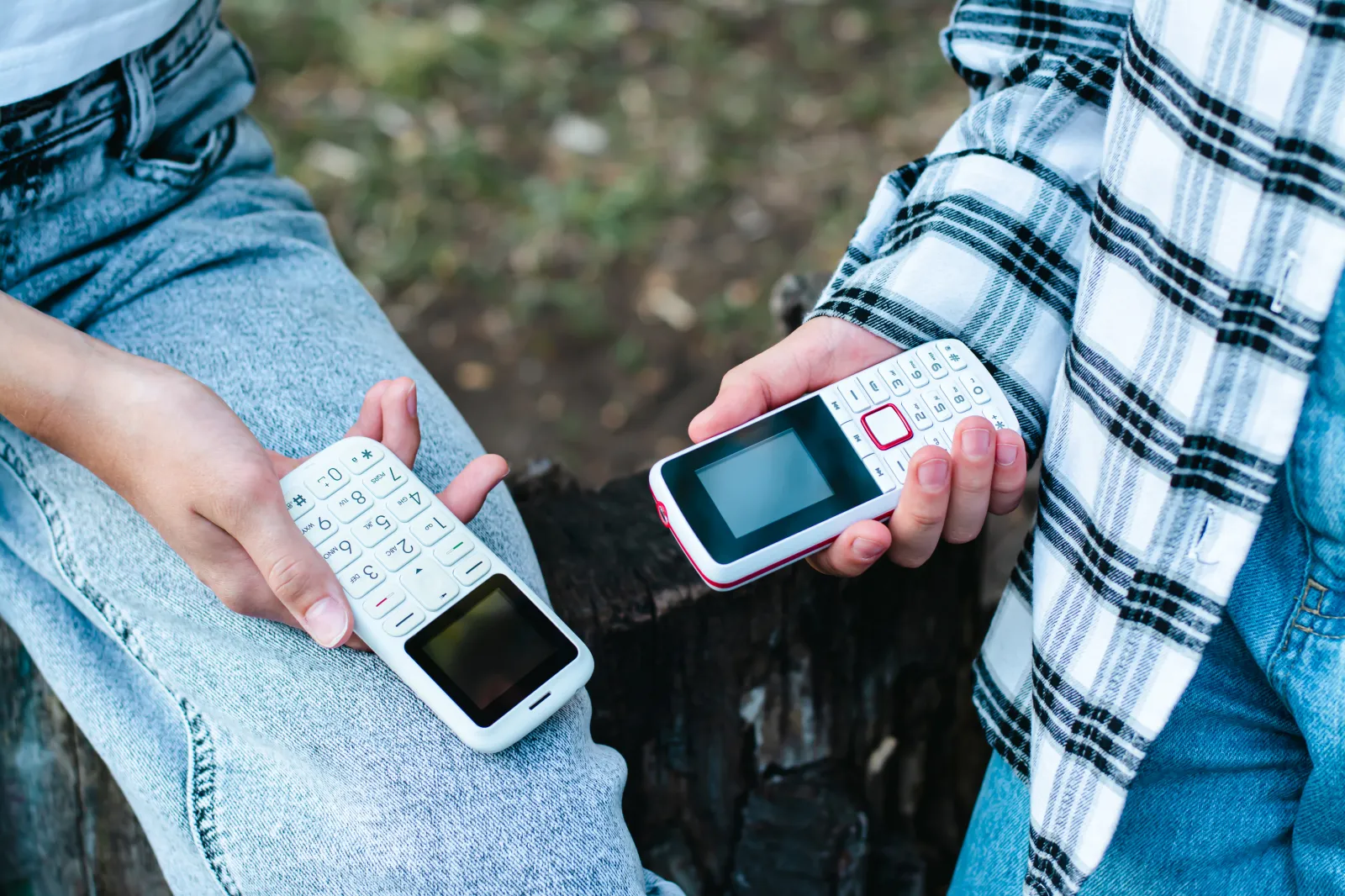
It is no accident that deliberately limited phones, with no social media and no constant notifications, have stopped being a nostalgia item (or the choice of someone who cannot afford a better phone) and become objects of desire sold at flagship prices [5]. The limitation is now the value proposition. This changes the yardstick for anyone designing products or communication: the question is no longer only “how do we hold attention” but also “how do we earn the time of someone who is trying to pay less attention to everything”.
Photo: Getty Images, via Newsweek.
How did physical space become a selling point?
Hospitality and retail are where this logic takes shape, literally. Hotels that deliberately invest in screen-free environments, with no digital signage and no check-in kiosks, report something consistent: guests remember the room less and the spontaneous conversation at the bar more, along with the handwritten menu and the sign that does not blink [4]. Projects that once would have used a screen to announce an event time or the day’s offer are switching to physical, mechanical solutions with their own texture and sound, precisely because that point of friction is what separates a generic experience from one that becomes a story worth telling.
For anyone who specifies surfaces, lights interiors or designs a reception area, this is the most actionable insight in the whole conversation about the analog revival: commercial value is moving toward the finish you can feel, the material that ages with its own patina, the controlled imperfection no screen can simulate. Wood that marks with use, metal that oxidizes in its own way, wallpaper with real relief: each of these is no longer just an aesthetic decision and now carries part of the commercial case for the space.

Photo: courtesy of Oat Foundry.
“A space with no screens at all still competes for attention, but it changes weapons: instead of brightness and motion, it relies on texture, sound and the slowness of someone in no hurry to scroll to the next thing.”
What does this change for those who design, specify or communicate?
None of this is a rejection of technology; it is a response to excess. The same people who buy a turntable still carry a smartphone; the difference is that they no longer accept it taking up every inch of the experience. That opens very concrete room for brand, product and architecture: creating moments and surfaces that do not compete with the screen, and that work precisely because they do not try to be faster or brighter than it.
For those starting out in the profession, the lesson behind the numbers is simple to state and hard to execute: the physical object and the built space are competitive advantages again, not because technology failed, but because it delivered too well on its own promise of speed and abundance, and people found out they also need the opposite.
Read more
- Authenticity in design and architecture: what artificial intelligence cannot copy
- 2026 Design Trends: Design Moves from Spectacle to Support
Referências
[1] WGSN. “Comportamento analógico: o futuro é offline?” WGSN Blog, May 8, 2026. Available at: https://www.wgsn.com/pt/blog/comportamento-analogico-o-futuro-e-offline
[2] Matthew Leimkuehler. “Vinyl Sales Surpassed $1 Billion In 2025: Report.” Forbes, March 16, 2026 (data from the Recording Industry Association of America). Available at: https://www.forbes.com/sites/matthewleimkuehler/2026/03/16/vinyl-sales-surpassed-1-billion-in-2025-report/
[3] Emma Ayers. “Generation Z bringing back the flip phone in ‘dopamine diet’.” The Washington Times, April 18, 2025 (with data from Harris Poll, PNAS Nexus and PYMNTS Intelligence). Available at: https://www.washingtontimes.com/news/2025/apr/18/generation-z-bringing-back-flip-phone-young-people-go-dopamine-diet/
[4] Melissa Houghton. “Boutique Hotel Design: Prioritizing Craft, Texture, and Analog Detail.” Oat Foundry Blog, January 28, 2026. Available at: https://www.oatfoundry.com/blog/analog-hotel-signage-and-decor/
[5] Melissa Fleur Afshar. “How To Instantly Dumb Down Your Smartphone for a Scrolling Detox in 2026.” Newsweek, December 26, 2025. Available at: https://www.newsweek.com/how-to-instantly-dumb-down-your-smartphone-for-a-scrolling-detox-in-2026-11271891